 Mary Janine L. Kamenić
 Julianna Widlund P.E
 Stevan Lukic CEng
Since the AI research boom that kicked off in 2022, the construction industry has been quietly rewiring how cost work gets done — and AI in quantity surveying sits right at the centre of that shift. For decades, quantity surveyors and estimators have carried the weight of manual PDF drawing takeoffs, line-by-line document checks, and the ever-present risk of cost overruns. Paper-based workflows don't just slow projects down; they put budgets and timelines at risk.
This article breaks down — technically and practically — how construction automation is reshaping quantity surveying, through three real-world case studies:
Automated quantity takeoffs from PDF CAD drawings
Checking documents for discrepancies against specifications
Extracting prices from complex Schedule of Rates tables
By the end you'll see exactly how purpose-built quantity surveying software turns tedious, error-prone tasks into fast, auditable processes — and how to roll it out without an in-house data science team.
Want to see it on your own drawings? Book a free Civils.ai demo and let AI run your next takeoff from day one.
Key takeaways (TL;DR)
The bottleneck is manual extraction. Reading drawings, cross-referencing specs and pulling rates from PDFs eats the hours that should go into analysis.
AI replaces extraction, not judgement. Computer vision measures drawings; NLP reads specs and rate tables; you keep the decisions.
Results are measurable. Reported gains include up to 70% less time searching CAD PDFs and up to 50% less data-entry effort on rate schedules.
Citations matter. The difference between a general-purpose chatbot and AEC-grade tooling is verifiable, page-level sources — not confident guesses.
Start small. Pilot on one package, track time saved and error rates, then scale.
The shift from traditional to AI-driven quantity surveying
Traditional quantity surveying
Picture a typical Monday: stacks of PDF drawings, measuring off quantities by hand to get a takeoff out the door. This paper-based workflow has defined quantity surveying for years — heavy on manual data extraction and endless cross-referencing. It's laborious, exposed to human error, and a single missed dimension can snowball into a real cost overrun.
The hidden cost is reactivity. When a spec changes or a labour rate moves, surveyors dig through spreadsheets, handwritten notes and email threads to find the right numbers. The result is delayed bids, misaligned budgets and frustrated stakeholders.
How AI elevates quantity surveying
Now imagine the repetitive layer handled by machine learning. Instead of hunting line by line for rates, quantity surveying software scans, measures and verifies material requirements directly from complex drawings. Under the hood, two technologies do the heavy lifting:
Computer vision / object detection — locates, classifies and measures elements (lines, areas, counts) across varied drawing formats, including scanned PDFs.
Natural language processing (NLP) — reads dense specifications, contracts and rate tables, then extracts the relevant requirements and figures into structured data.
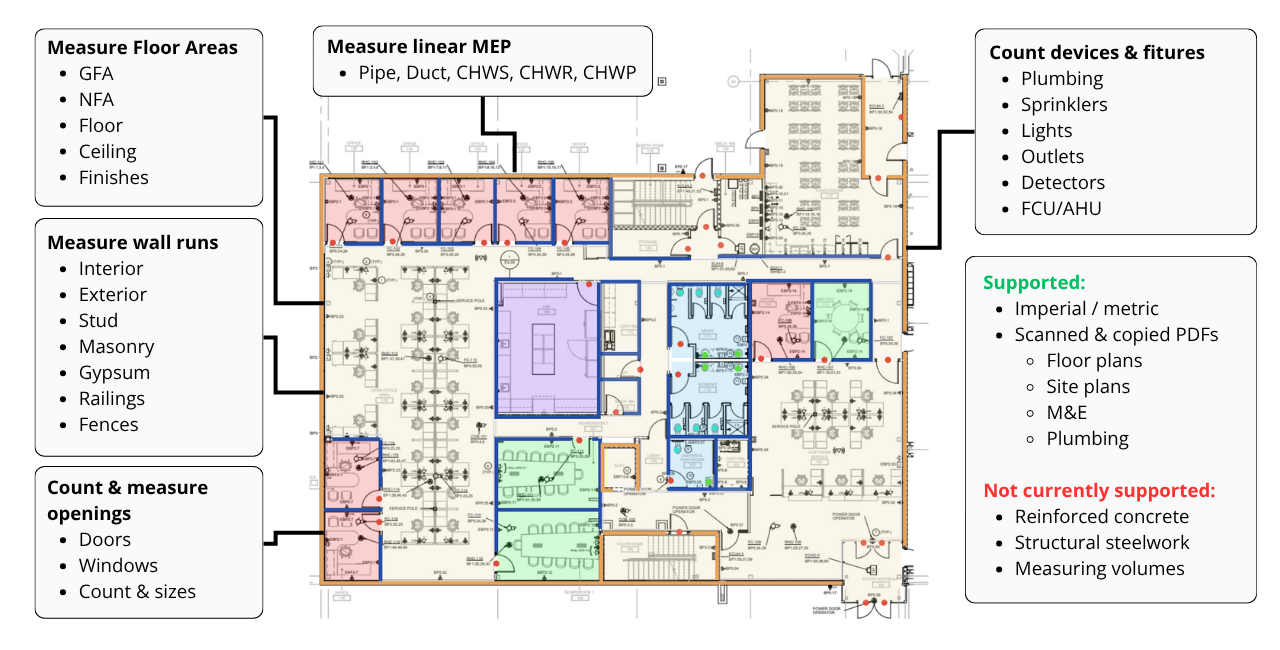
Crucially, digital transformation in construction isn't about swapping paper for pixels — it's about reimagining the workflow. Platforms like Civils.ai ship pre-built AI workflows for quantity surveyors, so you don't need a team of data scientists to benefit. As these systems scale with your organisation, they cut error rates, improve collaboration, and free your team for higher-value analysis.
Case studies: AI in action for quantity surveyors
Case study 1 — Automated quantity takeoffs from PDF CAD drawings
The challenge. Manually reviewing PDF CAD drawings is a grind. Overlook one dimension and the whole budget shifts. When deadlines tighten, manual checking becomes the bottleneck.
The AI-driven solution. Vision models read the drawing the way an estimator does — detecting objects, measuring lengths and areas, and counting items — then write the results into a structured takeoff. Marked-up sources are kept so every quantity can be traced back to where it came from on the drawing.
Civils.ai vs general-purpose AI | ||
Capability | Civils.ai (AEC-focused) | General-purpose AI |
|---|---|---|
Reads & measures drawings | Built-in — yes | Not built-in — no |
Annotates / marks up drawings | Yes | No |
Reads complex tabular data (datasheets, rates, geotech reports) | Extracts to structured formats | Not reliable |
Run AI searches across documents | Yes — unlimited documents | Yes — up to ~10 documents |
Cites & opens original documents | Marked-up sources always provided | Limited support |
Capabilities reflect default product focus; some items depend on plan, integrations and configuration.
The impact. Some users report a 70% reduction in time spent searching for information in CAD PDFs, freeing resources for strategic work. Fewer manual errors flow straight through to better procurement planning, smoother workflows and fewer budget surprises.
Case study 2 — Checking proposals and bids against specifications

The challenge. Making sure every proposal or bid lines up with the project spec can feel like searching for needles in a haystack. Missed line items, overlooked addenda or mismatched terms lead to costly delays and disputes downstream.
The AI-driven solution. Using NLP, Civils.ai compares bid proposals against the official project spec and surfaces inconsistencies or missing requirements. Teams get a concise summary report and can resolve discrepancies quickly — before the bidding process escalates.
The impact. Replacing exhaustive manual reviews with automated checks cuts the risk of errors slipping through, speeds up bid evaluation, and lets teams negotiate and finalise contracts with confidence. The outcome is a more transparent process that keeps stakeholder trust intact.
Case study 3 — Extracting rates from PDF schedules automatically

The challenge. Surveyors routinely sift through dense PDF schedules to find current material and labour rates — often to check Variation Orders. It's slow and mistake-prone, especially with last-minute updates or multiple document versions.
The AI-driven solution. Civils.ai's document-parsing engine reads complex tables line by line, identifies and captures rate details, and writes them into a clean spreadsheet or database in seconds. No copy-pasting, no fear of missing a small-but-critical figure.
The impact. Clients report cutting data-entry effort by up to 50%. More importantly, automated checks reduce human error, producing more precise estimates that help prevent cost overruns — so surveyors spend less time hunting figures and more time analysing them.
Beyond takeoffs: AI for pre-construction contract & spec review
Quantity surveying doesn't end at measurement. A large share of risk is buried in contracts, specifications and codes of practice — which is exactly where AI search with page-level citations earns its keep. Here are the most common pre-construction use cases.
Contract review before signing off
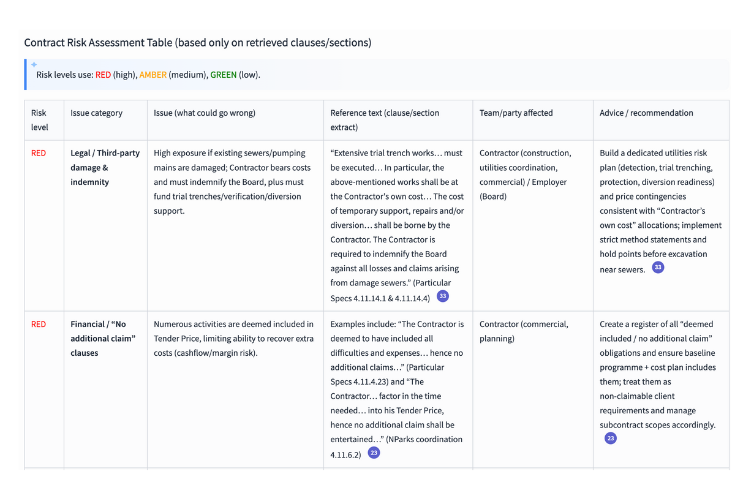
Risk review — identify key clauses, exclusions and obligations across contracts and specs, each cited to the exact page and section.
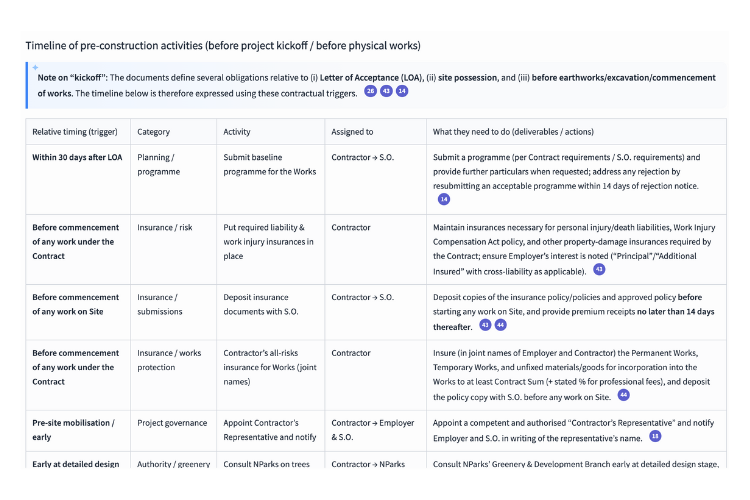
Timelines & deliverables checklist — extract submission dates, review periods, approvals and required deliverables into a clear checklist that keeps packages on track.
Specification compliance checking
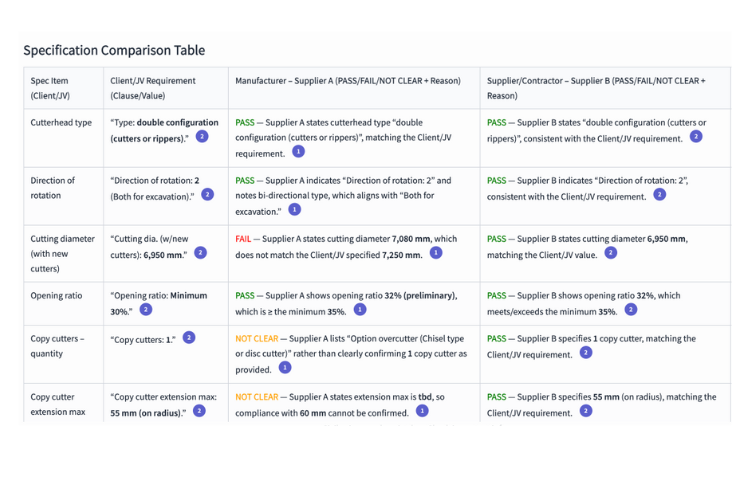
Compare subcontract specs to client specs — cross-check subcontractor scope, inclusions and compliance against client requirements, flag gaps and conflicts before signing, and score each option with a decision matrix.
Run a checklist of queries against specs — search across the specifications listed on drawings with a repeatable query checklist to flag project requirements when deciding whether to bid.

Code of practice compliance
Library search — run code-compliance queries across your full library of codes of practice to surface relevant sections and requirements, with citations to the exact pages.
On site, on mobile — Civils.ai is web-based, so you can search your library from any phone or tablet during site walks, RFI responses and meetings — checking requirements in seconds.
How it works: build repeatable checks in minutes
There are two ways to use Civils.ai — create workflows for repeatable checks, or quick-search with prompts across your entire project library.
Define your workflow — list the questions, checks or risks to run across contracts, specs and drawings.
Point to your sources — upload files or integrate with your existing systems.
Run — execute every check in one go, returning evidence-backed answers with references.
Standardise reviews — reuse workflows for bidding, tender compliance and contract onboarding.
Why Civils.ai: your AI-powered partner for quantity surveying
Pre-built workflows
Ready-made solutions for quantity surveyors — no costly custom AI build.
Slots into existing operations, from PDF parsing to automated spec checks.
User-friendly platform
Drag-and-drop upload; data is extracted automatically, no technical skills required.
Real-time dashboards and reports for fast decisions and early warning on discrepancies.
Scalability & support
Scales from small renovations to large commercial projects.
Ongoing training, webinars, tutorials and proactive support.
Getting started: an action plan for AI integration

1. Quick self-assessment
Before adopting AI, evaluate your current process:
Which tasks drain the most time? Manual data entry? Bid comparisons or rate processing delaying timelines?
Where do errors commonly occur? Overlooked line items, miscalculated rates, documentation discrepancies?
Pinpointing bottlenecks tells you what to automate first — and where the highest ROI sits.
2. Choose your AI tools
Weigh in-house development against a specialised platform:
Budget — cost of building and maintaining a custom solution vs a subscription platform.
Team skills — do you have IT or data science expertise in-house?
Urgency — how quickly do you need results on live projects?
3. Pilot on a small project
Validate on one phase or a smaller bid, and track:
Time saved vs manual processes.
Error rates — fewer discrepancies or change orders?
Overall ROI — do faster, more accurate bids offset the platform cost?
4. Train & scale
Provide role-specific training and reference guides.
Use built-in Civils.ai training modules and live support.
Once value is proven, scale across projects in phases.
Frequently asked questions
What document types does AI quantity surveying software handle?
Construction contracts (NEC, JCT, FIDIC), employer's requirements, specifications, drawings and codes of practice — PDF, scanned or digital. Every answer returns with citations to the exact pages and sections.
Can I save reusable checks for bid reviews?
Yes. Build a workflow once — a list of questions, risks or compliance checks — then re-run it against every new contract or tender pack you receive.
How accurate are the answers?
Every answer is grounded in your source documents and cited back to the exact page, so you can verify in one tap. Nothing is fabricated and nothing is hidden.
Can it compare a subcontract pack to client requirements?
Yes. The platform cross-checks subcontract scope, inclusions and compliance against client specs, flags gaps and conflicts, and can score each subcontractor with a decision matrix.
How is uploaded data handled and who owns it?
Data is stored securely with a vetted cloud provider and transmitted over TLS. You retain full ownership of every document you upload — your data is never used to train models or shared with third parties.
Does it work on mobile when I'm on site?
Yes. It's web-based, so you can search your library of codes of practice and project documents from any phone or tablet — useful for site walks, RFI responses and meetings.
Conclusion
From automated PDF extractions to fast CAD searches, AI in quantity surveying has proven itself a genuine step-change. The three case studies show how construction automation cuts manual work, reduces human error and delivers measurable ROI — while page-level citations keep every answer auditable. Backed by turnkey AI workflows, quantity surveyors can move from outdated processes to a modern, data-driven approach without rebuilding their stack.
Join the future of quantity surveying. Don't let traditional methods hold you back — schedule a demo today to see how AI-driven efficiency can transform your next project.