 Mary Janine L. Kamenić
 Julianna Widlund P.E
 Stevan Lukic CEng
Quick Summary
Topic | Key Finding |
|---|---|
Primary risk | Late addenda are a leading cause of scope misses on bid day |
Estimator time on document review | 38% (ASPE research) |
When scope gaps surface | Typically at buyout — after award, when remediation is costly |
Addenda volume per project | 8–12 on mid-size projects; 20+ on large institutional pursuits |
AI query speed | Civils.ai Chat Agent returns sourced addendum answers in under 20 seconds |
Scope package generation | Under 60 minutes with AI-assisted tools vs. 30–40 hours manually |
Margin risk driver | Scope-transfer clauses in addenda that shift trade responsibility undetected |
Why Addenda Management Is Still a Manual Problem
Most general contractor teams use outdated approaches to manage addenda — downloading files, logging them in spreadsheets, emailing subcontractors, and hoping everyone updates their bids before submission deadlines close.
Addendum: A formal document issued by an owner or architect during the bidding period to modify the original bid documents. Addenda are legally binding and supersede the original documents they revise.
This manual process contains four critical failure points:
Volume. Mid-size projects generate 8–12 addenda; large institutional pursuits can exceed 20. Each document may span 20 to 100 pages.
Timing. Owners and architects release addenda right up to bid day, with some arriving within the final 24 hours or even the final hour.
Distribution. If a critical-path subcontractor does not receive updated scope information, their pricing reflects outdated documents, and the general contractor absorbs the difference.
Processing speed. Experienced estimators cannot thoroughly read and cross-reference a 47-page addendum in 43 minutes while simultaneously managing active bid operations.
The predictable outcome is missed scope items. These omissions typically remain undetected until buyout, when awarded contract terms conflict with subcontractor pricing based on superseded drawings.
What a Missed Addendum Actually Costs
The cost extends far beyond the individual line item. It includes change orders, strained subcontractor relationships, and permanently lost margin.
Realistic scenario: An addendum modifies mechanical scope on one floor, shifting rough-in responsibility from the mechanical subcontractor to the general contractor's self-perform crew. The specification note reflecting this transfer appears on page 31 of Addendum No. 6. An estimator identifies the drawing revision but overlooks the corresponding specification language. The general contractor bids the work, wins the contract, and executes it at unplanned cost.
This is a recurring pattern, not an isolated incident. Scope gaps tied to late document modifications are among the most reliable sources of margin erosion in competitive bidding because they are difficult to locate and easy to overlook.
Civils.ai has analyzed over $100 billion in project value and processed more than 66,000 documents across actual general contractor bids. Scope gaps connected to late document modifications appear consistently across projects of all sizes and categories.
The Root Cause: Too Much Document, Too Little Time
ASPE research indicates estimators spend 38% of their time on document review, covering initial takeoff assessment, RFI handling, and addenda management. During competitive pursuits with compressed bid windows, this 38% must contract — and addenda review is frequently the first element to receive insufficient attention.
The obstacle is not insufficient effort. The obstacle is information volume. Construction documents are content-dense. Complete project sets — drawings, specifications, addenda, contracts, and supplementary conditions — frequently exceed 2,000 pages. Identifying scope-relevant modifications in late addenda requires reviewing every page, understanding context, and recognizing how changes interact with base bid documents.
How Addendum Tracking Breaks Down in Practice
The "I'll flag it for later" trap
Estimators managing bid day oversee simultaneous communications — subcontractor calls, scope clarifications, bid reconciliation. When late addenda arrive, the instinct is to flag the documents, quickly scan them, and address them after numbers arrive.
The problem: "after numbers arrive" frequently becomes "after submission already occurred." The flag becomes a post-bid discovery rather than a scope revision.
The "we already sent it to subs" assumption
Distributing addenda to subcontractors does not guarantee they read it, understood it, or adjusted their pricing. Specialty subcontractors managing multiple bids simultaneously face identical time constraints.
The safer approach: unless a subcontractor explicitly confirms they have priced Addendum No. X, treat their submission as pre-addendum.
The scope-transfer problem
Scope transfer: An addendum modification that reassigns responsibility for a specific work item from one trade to another, or from a subcontractor to the general contractor, without adding or removing the work itself.
This pattern is the most dangerous. Addenda do not merely introduce or eliminate work — they shift scope among trades, between the general contractor and subcontractors, or among contract documents. These transfers resist detection because they require reading addenda in context. You must understand what base documents stated to recognize what changed and how that modification affects scope allocation.
What a Reliable Addendum Tracking Process Looks Like
General contractors with minimal bid-day surprises follow comparable patterns. The process is not complex, but it requires discipline and appropriate tools.
Step 1: Log every addendum the moment it drops
Designate one person to maintain the document log. Every addendum receives an entry recording:
Issue date
Page count
Brief description of affected areas
This log is your audit trail if scope disputes arise after bidding.
Step 2: Triage before you read
Not every addendum modifies your scope. Some are administrative — bid period extensions, substitution approvals, non-scope clarifications. Triage addenda quickly before committing reading time. Identify which sections, drawing numbers, and specification divisions are affected. Then direct to the appropriate estimator.
Step 3: Cross-reference against your scope package
Any addendum item affecting a specification division or drawing you have already quantified requires immediate comparison:
What did the original document state?
What does the revised document indicate?
What is the difference?
That differential is either additional scope requiring coverage, deleted scope you can remove, or a scope reassignment needing reallocation.
Step 4: Notify subs with specific callouts
Do not simply forward the addendum. Tell the subcontractor precisely what changed and how it affects their scope. A specific callout — "Addendum 7, Sheet M-204 revised, mechanical rough-in on Level 3 updated, please confirm your pricing reflects this" — generates faster and more reliable response than a file attachment without context.
Step 5: Document the close
Before submission, document in writing which addenda your bid incorporates. Note any items you identified but could not fully assess within the available timeframe. That documentation provides protection if scope questions surface following award.
Where AI Changes the Math
Manual addendum tracking is slow — not because individuals lack capability, but because the task is genuinely complex. Reading 47 pages in 43 minutes while cross-referencing a 2,000-page project set is a volume problem, not a competency problem.
This is where purpose-designed construction AI changes the calculation.
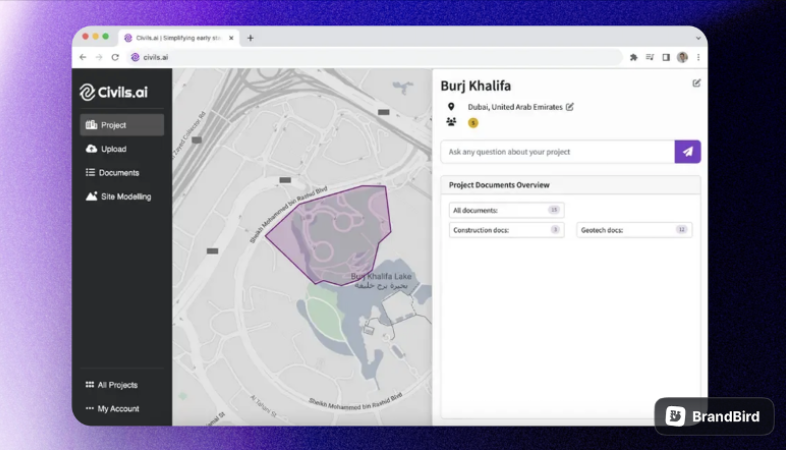
Civils.ai's Chat Agent allows estimators to query complete project document sets — drawings, specifications, contracts, RFIs, and addenda — using natural language. You can ask: "What changed in Addendum 7 for Division 15?" and receive a sourced answer in under 20 seconds. The citation links to the exact page and document, enabling personal verification.
This is not a general-purpose text summarizer. It is construction document AI trained to recognize specification structure, drawing protocols, and addendum interactions with base documents. It covers complete project sets — not just contracts or isolated document types, but the entire package.
What this means for bid-day addenda management:
Immediate scope evaluation — which divisions and drawings did this addendum affect?
Change assessment — how does this revision differ from the base document?
Scope transfer recognition — did responsibility for a task shift among trades?
Subcontractor notification support — what exactly should you communicate about this revision?
Capability | Detail |
|---|---|
Queries processed | Over 50,000 across actual project documents |
Verified accuracy | 95% across those document sets |
Accuracy vs. general-purpose AI | 5x more accurate than ChatGPT on construction specifications |
Risk Review accuracy | 99.5% on risk items including scope transfers and changed responsibility clauses |
For risk items embedded in addenda — scope transfers, changed responsibility clauses, modified insurance conditions — Civils.ai's Risk Review tool identifies these automatically against pre-built parameters. Your team is not manually reading for risk. The tool identifies it and indicates where attention is needed.
The Sub Communication Problem on Bid Day
Even when your internal team identifies every addendum modification, distribution challenges persist. You need subcontractors to confirm their pricing reflects current documents — and on bid day, subcontractors face equivalent pressures.
The highest-performing teams send addendum notifications that are specific and concise. "Addendum 6, revised Drawing E-301, added emergency egress lighting at stair 4 — please confirm your pricing includes this" generates response. Bulk forwarding a 47-page PDF does not.
When using Civils.ai's Scope Agent, your scope packages already incorporate current document modifications. When you distribute scope to subcontractors for coverage verification, you are not requiring them to cross-reference addenda independently — you are delivering a current, addendum-inclusive scope document. This meaningfully decreases coordination risk on bid day.
Scope package generation time comparison:
Method | Time to Generate Scope Package |
|---|---|
Manual (traditional) | 30–40 hours per bid |
Civils.ai Scope Agent | Under 60 minutes |
This work typically occurs before bid day, not during it — preserving bid-day capacity for coordination and decision-making.
The Real Competitive Edge: Process, Not Hustle
One approach to bid-day addenda management relies on individual effort — diligent estimators working extended hours, catching items through experience and close attention. This approach works until it does not.
One missed addendum. One scope reassignment nobody identified. One subcontractor who priced based on obsolete drawings. That becomes a change order dispute, a margin reduction, or both.
General contractors winning more bids at better margins have built a system: clear document responsibility, rapid triage, AI-assisted assessment, targeted subcontractor communication, and a documented confirmation before submission.
That system scales. It does not depend on a single individual. It does not collapse when managing five simultaneous pursuits. It identifies the scope transfer on page 31 of Addendum No. 6 even when 43 minutes remain.
Frequently Asked Questions
What is addendum tracking in construction bidding?
Addendum tracking is the process of documenting, analyzing, and communicating document modifications distributed by an owner or architect during the bid period. It involves recognizing how each addendum affects scope, alerting subcontractors, and confirming that final bid amounts reflect all current documents. Most teams manage addenda manually — via spreadsheet and email — which introduces risk when addenda arrive near submission deadlines.
Why do late addenda cause scope misses?
Late addenda cause scope misses because there is insufficient time to thoroughly read, cross-reference, and respond to document modifications before bid submissions close. The risk intensifies when an addendum reassigns scope among trades or between the general contractor and a subcontractor — modifications that require reading both revised and original documents in context.
How much time do estimators spend reviewing addenda?
ASPE research shows estimators spend 38% of their time on document review, which includes addenda management. On competitive bids with compressed timelines, this time is further reduced — making addenda review one of the most time-pressured and highest-risk estimating tasks.
How does AI help with bid-day addendum management?
AI systems built for construction documents can assess an addendum in seconds — identifying which specification divisions and drawings changed and how they differ from base documents. Civils.ai's Chat Agent answers natural-language questions across complete project document sets with sourced responses in under 20 seconds. This allows estimators to focus on decisions rather than document searching when time is short.
What is the difference between an addendum and a change order?
An addendum is issued before contract award, during bidding, to modify the bid documents. A change order is issued after award, during construction, to modify the contract. Scope missed in an addendum frequently generates change order disputes later — because the contractor bid based on older documents, but the contract reflects the current ones.
How should GCs communicate addendum changes to subcontractors on bid day?
Send targeted callouts rather than bulk file distributions. Specify the exact sheet, specification section, or scope element that changed, and explain what it means for their work. Require explicit confirmation that their pricing reflects the modification. A focused message generates faster response than a 47-page attachment without context — and that confirmation protects you if their number does not include the change.
Can Civils.ai work across the full project document set, including addenda?
Yes. Civils.ai's Chat Agent operates across the complete project set — drawings, specifications, contracts, RFIs, and addenda. It is not limited to contracts or individual document types. This matters on bid day, when addendum changes intersect with base specifications and drawings and you need answers that reflect the full document collection.