 Mary Janine L. Kamenić
 Julianna Widlund P.E
 Stevan Lukic CEng
Quick Summary
| Topic | Key Finding |
|---|---|
| Document volume | A typical 2026 commercial bid set runs 800–2,000 pages |
| Estimator time spent on review | 38% of total estimator time — more than takeoff or pricing on many bids |
| Primary cause of scope gaps | Broken review process under time pressure, not estimator error |
| Impact of missed scope | A single missed spec on a $20M project can cost $200K–$800K in unbudgeted work |
| AI time reduction | Purpose-built construction AI tools reduce review time by up to 80% |
| Review order that matters most | Contract and Division 01 before drawings |
Why Document Review Takes So Long
A commercial bid set in 2026 averages 800 to 2,000 pages. That includes drawings, specifications, contracts, addenda, geotechnical reports, and supplementary conditions. No single estimator reads all of it.
Where Scope Gaps Most Commonly Originate
- Spec sections not cross-referenced to drawings — a note on a structural drawing points to a spec section that was never pulled
- Division 01 requirements missed — temporary facilities, commissioning requirements, and project schedule constraints buried in general conditions
- Late addenda not fully distributed — changes issued on day 14 that do not reach every trade or scope package
- Supplementary conditions skimmed or reviewed last — liquidated damages clauses, insurance limits, and indemnification language that shift risk to the GC
- Sub scope overlaps and gaps — work that falls between trades because nobody assigned it explicitly
These are failures of process, not failures of effort.
The Construction Document Review Process: A Step-by-Step Framework
This framework is built for GC pre-construction teams bidding mid-size commercial projects ($5M–$100M).
Step 1: Triage the Document Set Before Reading Anything
Before your team touches a single drawing, spend 30 minutes doing a document inventory. Log every file received. Check it against the project manual index. Identify what is missing.
Ask these questions upfront:
- Do you have the full spec book, or just selected divisions?
- Are there any addenda already issued at the time of distribution?
- Is the geotechnical report included, or does it need to be requested?
- Has the owner or CM issued any pre-bid substitution requests?
Step 2: Read Division 01 First — Not Last
Most estimators start with the drawings and skim Division 01 at the end. That is backwards.
Division 01 contains schedule constraints that affect GC overhead calculations directly. Reading it before pulling any quantities can move a GC&P estimate by 3–8% on a complex project.
Step 3: Review the Contract and Supplementary Conditions for Risk Exposure
Commercial and legal risk lives in the contract documents, not the drawings. Review these sections before beginning scope work:
| Contract Element | What to Look For |
|---|---|
| Liquidated damages | Dollar amount per day, substantial completion definition |
| Indemnification clauses | Broad-form vs. comparative fault |
| Insurance requirements | Limits, additional insured language, umbrella requirements |
| Payment terms | Schedule of values requirements, holdback percentage, payment timing |
| Change order markup caps | Many owner agreements cap overhead and profit on changes |
| Dispute resolution | Arbitration vs. litigation, jurisdiction |
Step 4: Cross-Reference Drawings and Specifications by CSI Division
Work through the project division by division. For each CSI division, confirm:
- What does the specification require?
- What do the drawings show?
- Do they agree? If not, which governs?
- Is there work shown on drawings with no corresponding spec section?
- Is there a spec section with no corresponding drawing detail?
Document discrepancies as RFIs. Do not assume. Do not resolve conflicts internally.
Step 5: Review Addenda in Chronological Order — Then Re-Check Everything They Touch
The process for addenda review:
- Log each addendum as it arrives, with date and addendum number
- Read the full addendum — not just the clouded revision on the drawing sheet
- Identify every drawing or spec section the addendum touches
- Return to those sections in review notes and update them
- Re-distribute updated scope to affected trades before buyout
Step 6: Build Scope Packages from the Review — Not from Templates
The output of document review should not just be notes. It should be the foundation of scope packages for subcontractor solicitation.
Every scope gap identified during review is a gap sub bids will not cover. Every ambiguity skipped becomes a change order dispute after award.
Where Pre-Construction Teams Lose the Most Time
Problem: Estimators Search the Same Documents Repeatedly
A team member spends 15 minutes finding the waterproofing spec. Two days later, someone else on the team finds it again. Then a sub calls and asks about the membrane type, and it gets searched a third time.
The fix is a shared document Q&A layer the whole team can query — not faster individual searching.
Problem: Contract Risk Review Gets Cut When the Bid Timeline Compresses
When bid day moves up or the team is stretched across multiple pursuits, contract review is typically the first task eliminated. This is also where the most expensive gaps originate.
Problem: Scope Packages Do Not Reflect What the Documents Actually Say
Pre-construction teams under pressure write scope packages from memory and prior project templates. That is acceptable when the project matches the template. It becomes a problem when the spec requires something different and nobody caught it during review.
How AI Changes the Construction Document Review Process
AI tools for construction document review fall into two categories:
- Generic AI tools (such as ChatGPT and Microsoft Copilot): adapted for construction use but not purpose-built for it. These tools hallucinate contract terms, misidentify division numbers, and cannot reliably distinguish between base spec and supplementary conditions.
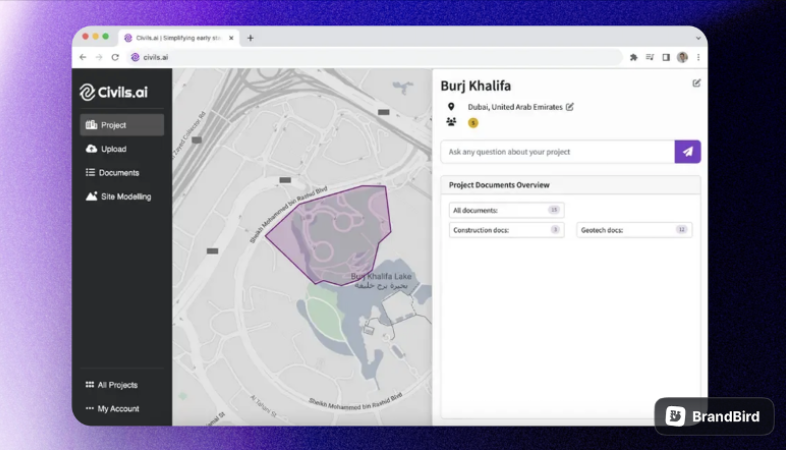
- Purpose-built construction AI tools: trained specifically on construction documents — drawings, specs, contracts, RFIs, addenda — and understand how these documents interrelate. Civils.ai is built for this use case.
AI Review Time Benchmarks
| Review Task | Manual Time (avg) | With Purpose-Built AI |
|---|---|---|
| Contract risk checklist | 4–8 hours | Under 20 minutes |
| Spec section queries (per bid) | 15–25 hours | Minutes (with cited answers) |
| Scope package generation (all trades) | 30–40 hours | Under 60 minutes |
| Addenda cross-reference check | 2–5 hours | Minutes |
Building a Repeatable Document Review Checklist
Speed without a system produces faster mistakes. The following checklists are designed to run on every pursuit.
Pre-Review Checklist
- Document set received and inventoried against project manual index
- All addenda logged with issue dates
- Geotechnical report received (if applicable)
- Pre-bid meeting minutes reviewed
- Bid form reviewed — alternates, unit prices, and allowances noted
Contract and Risk Review Checklist
- Liquidated damages clause reviewed and priced
- Insurance requirements logged and checked against current policy
- Change order markup cap identified
- Substantial completion definition confirmed
- Indemnification and waiver of subrogation language flagged
- Retention percentage and release terms noted
Scope and Drawing Review Checklist
- Division 01 reviewed before takeoff starts
- All CSI divisions cross-referenced to drawings
- Discrepancies between drawings and specs logged as RFIs
- Scope exclusion list drafted for each trade
- Bid clarifications documented for bid letter
Document Review for Subcontractors
GC pre-construction teams are not the only ones under pressure from document volume. Subcontractors reviewing GC-issued bid packages face the same challenges at a different project tier.
The same principles apply: contract risk first, scope clarity second, and addenda tracking throughout.
The Real Cost of a Broken Review Process
Scope gaps follow a predictable sequence:
- A spec requirement is missed during bid review
- The scope package sent to subs does not include it
- No sub prices it — because none were asked to
- The GC is awarded the contract and discovers the gap during scope review
- The work gets bought out at full cost — no competition, no leverage
On a $20M project, a single missed spec requirement can cost $200K–$800K in unbudgeted scope.
Frequently Asked Questions
How long should construction document review take for a mid-size bid?
For a $10M–$50M commercial project, manual document review typically takes 30–50 hours across an estimating team. Purpose-built AI tools such as Civils.ai are cutting that by up to 80% while maintaining or improving accuracy.
What is the most common cause of scope gaps in construction bids?
Scope gaps most often originate from missed Division 01 requirements, unresolved discrepancies between specs and drawings, and late addenda that were not fully distributed to trades.
Should I review the contract or the drawings first?
Contract documents first. Risk exposure from liquidated damages, insurance requirements, and change order markup caps affects bid strategy before any quantity work begins.
How does AI help with construction document review?
Purpose-built AI tools such as Civils.ai can query thousands of pages in seconds, run structured risk checklists against contract documents, and generate scope packages from complete document sets with cited source references.
What is the difference between using ChatGPT and a construction-specific AI for document review?
ChatGPT and similar general-purpose models hallucinate contract terms, misread spec references, and do not understand how construction documents are structured. Purpose-built construction AI is trained on the document types GCs and subs work with — specs, drawings, addenda, contracts, RFIs — and returns answers tied to the source document.
How do I build a repeatable document review process for my estimating team?
Start with a pre-review inventory, then move to contract risk review, then Division 01, then drawings and specs by CSI division, then addenda. Use the same checklist on every pursuit. Civils.ai supports this workflow by allowing the entire team to query a shared document set rather than searching independently.
Can smaller estimating teams handle more bid volume with better document review tools?
Yes. Most GC pre-construction teams are covering more pursuits with the same headcount. Purpose-built AI tools allow a team of three to move at the pace of a team of six by eliminating repeated document searches and automating structured review tasks.