 Mary Janine L. Kamenić
 Julianna Widlund P.E
 Stevan Lukic CEng
Photo by ThisisEngineering on Unsplash
JCT contract or NEC4? Compare how each handles payment, change, time bars, retention and disputes for subcontractors, and what to check before you sign.
Quick Summary
| Topic | Key Finding |
|---|---|
| Subcontract forms | JCT: SBCSub and SBCSub/D under SBC 2024. NEC4: the Engineering and Construction Subcontract (ECS) |
| Philosophy | JCT sets out rights and duties. NEC4 adds mutual trust and co-operation, early warnings and an accepted programme |
| Change | JCT values Variations. NEC4 assesses compensation events against time and cost |
| Biggest trap | The NEC4 time bar: 7 weeks for a subcontractor to notify a compensation event, against 8 weeks for the main contractor (NEC) |
| Payment floor | The Construction Act applies to both: payment notices, pay less notices, no pay-when-paid, a right to suspend |
| Where the real risk sits | In the amendments — the JCT schedule of amendments or the NEC Option Z clauses |
Most UK subcontractors will sign a JCT contract one month and an NEC4 subcontract the next. Both are standard forms, but they run on very different machinery, and the habits that keep you paid under one can lose you money under the other.
This guide is for UK subcontractors and the main contractor PMs who manage them: where JCT and NEC4 differ on money, what the law guarantees under both, and which amendments to check.
This article is general information, not legal advice. Contract wording, editions and amendments vary, so always read your own subcontract and take advice where a significant sum depends on it.
Key Term Definitions
JCT: The Joint Contracts Tribunal, which publishes the JCT families of building contracts and sub-contracts. The current edition is JCT 2024, which launched with the Design and Build family on 17 April 2024 (JCT).
NEC4 ECS: The NEC4 Engineering and Construction Subcontract, used to appoint works subcontractors where the main contractor is engaged under the NEC4 Engineering and Construction Contract (ECC) (NEC).
Compensation event: NEC’s term for an event that can change the Prices and the completion date. It replaces JCT’s separate treatment of Variations, extensions of time and loss and expense.
Pay less notice: A notice that the payer intends to pay less than the notified sum, stating the sum it considers due and how it is calculated (HGCRA 1996, s.111).
What Is a JCT Contract, and How Does NEC4 Differ?
A JCT contract follows a traditional structure. The main contract and sub-contract set out each party’s obligations, an administrator certifies, and the sub-contractor claims extra time and money through defined routes. Each JCT main contract has a matching sub-contract. Under the Standard Building Contract, that is SBCSub, or SBCSub/D where the sub-contractor designs part or all of its works (JCT). SBCSub can be priced as an adjusted sub-contract sum or by complete remeasurement.
An NEC contract is a management tool as much as a legal document. The ECS uses “the same definitions and procedures” as the main ECC, can include any level of design, and requires the parties to act in a “spirit of mutual trust and co-operation” and to give early warnings of anything that could affect time, cost or quality (NEC). The NEC4 contract offers five main payment Options in the ECS: A and B (priced, with an activity schedule or bill of quantities), C and D (target cost) and E (cost reimbursable). Your subcontract Option does not have to match the main contract’s.
You will still meet NEC3 subcontracts on older frameworks. Periods and clause numbers differ, so never assume NEC3 habits carry across.
Why Subcontractors Get Caught Out
- Treating NEC like JCT — under NEC4, a compensation event that is not notified in time can mean no change to the Prices or the programme at all.
- Copying the main contract’s numbers — subcontract periods are usually shorter, so the main contractor has time to pass your notice up the chain.
- Reading the standard form, not the amendments — the risk is rarely in the printed clauses. It sits in the Z clauses, the schedule of amendments and the documents they pull in.
- Missing payment notices — under the Construction Act, a missed pay less notice usually means the notified sum must be paid. The same discipline applies to your own applications.
These are failures of process, not of effort — and each is visible in the documents before you sign.
JCT vs NEC4: 7 Differences Subcontractors Must Check
1. The subcontract form and its links to the main contract
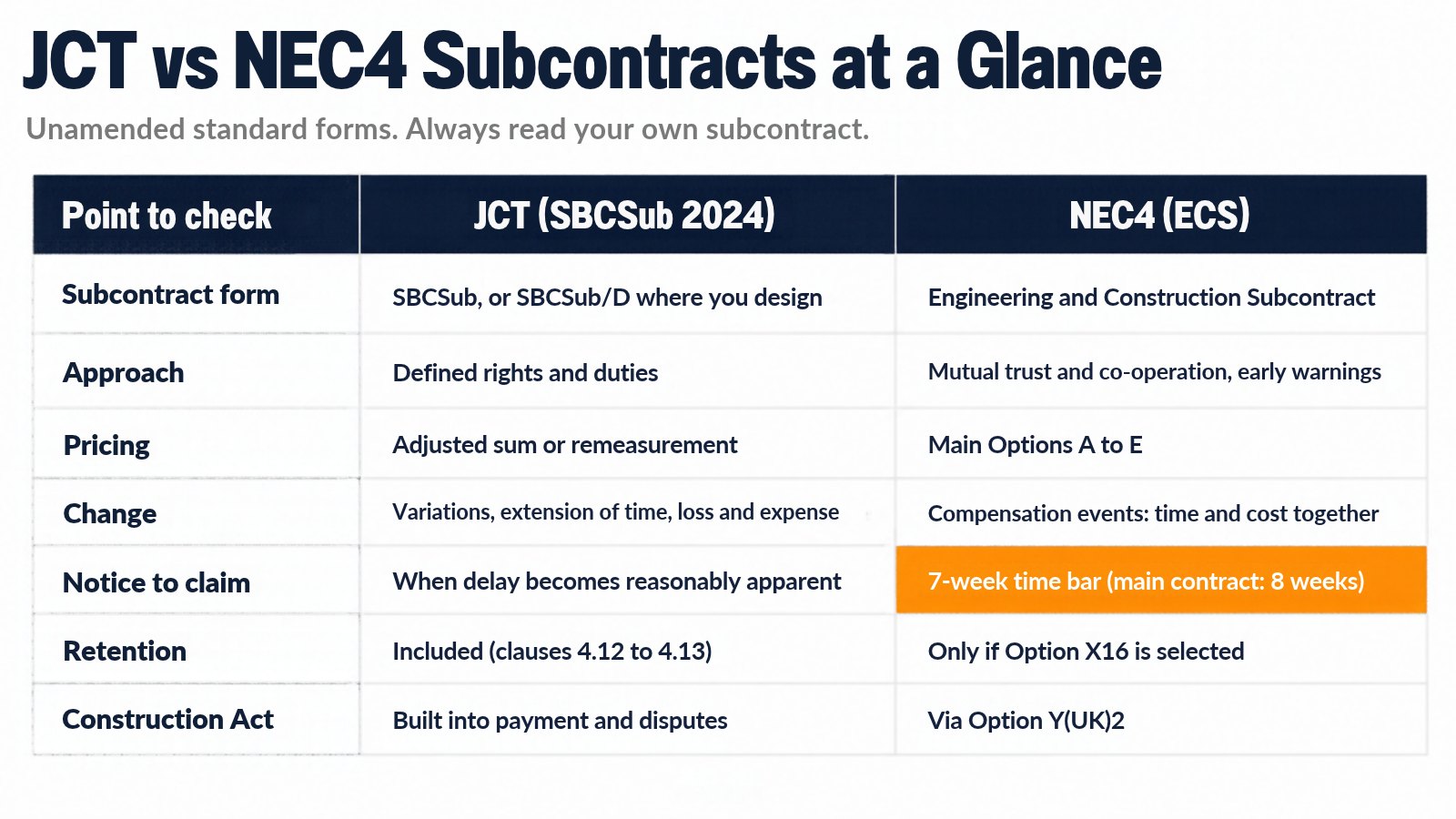
Check which form you are being offered and which main contract sits above it. SBCSub is drafted for the SBC 2024 main contracts. The ECS is drafted for the NEC4 ECC. A JCT sub-contract also includes duties to comply with the main contract (SBCSub/G contents, JCT), so ask to see the relevant main contract terms — access limits, programme constraints, design obligations — before you price.
2. How change is valued
Under JCT, instructed changes are Variations, valued under the Valuation Rules in Section 5 of SBCSub. Extra time comes through the adjustment of the period for completion (clauses 2.16 to 2.19), and money for disruption through loss and expense (clauses 4.14 to 4.18) (JCT).
Under NEC4, one process handles all three. A compensation event is notified, quoted for and assessed for its effect on both cost and time. Change is priced as you go, not argued at final account.
3. Notices and time bars
This is the biggest practical difference. Under the NEC4 ECC, clause 61.3 time-bars the main contractor if it does not notify a compensation event within 8 weeks of becoming aware it has happened; the equivalent period for a subcontractor under the ECS is 7 weeks (NEC). Miss it and you can lose the change to the Prices and the completion date. The clause has exceptions, so read it in full.
JCT delay notices are triggered when it becomes reasonably apparent that progress is being or is likely to be delayed, rather than by a fixed number of weeks. Do not wait: late notice weakens a claim, and amended JCT sub-contracts often add conditions precedent.
4. Programme and early warnings
NEC4 puts the programme at the centre: a continually updated and accepted programme is used to assess the time effect of change. Early warnings are a contractual duty, not a courtesy. Diarise programme submissions and keep early warnings specific.
5. Retention
SBCSub includes retention provisions as standard (clauses 4.12 and 4.13). In the ECS, retention applies only if Option X16: Retention is selected (NEC). Under either form, check the percentage and whether release is tied to events outside your control.
6. Errors, discrepancies and design responsibility
SBCSub deals with errors, discrepancies and divergences in clauses 2.8 to 2.12; SBCSub/D adds the sub-contractor’s design work (JCT). Under NEC4, design responsibility depends on what the Subcontract Scope says and whether Option X15 (the Subcontractor’s design) is used. Under both, amendments that make you responsible for errors in documents you did not prepare are a red flag.
7. Disputes
Both forms provide for adjudication, as the Construction Act requires. SBCSub Section 8 covers mediation, adjudication and arbitration or litigation. The ECS uses dispute resolution Options W1 or W2 (NEC); in UK construction contracts covered by the Act, check which one your subcontract selects and how it fits the main contract.
What the Construction Act Guarantees Under Either Form
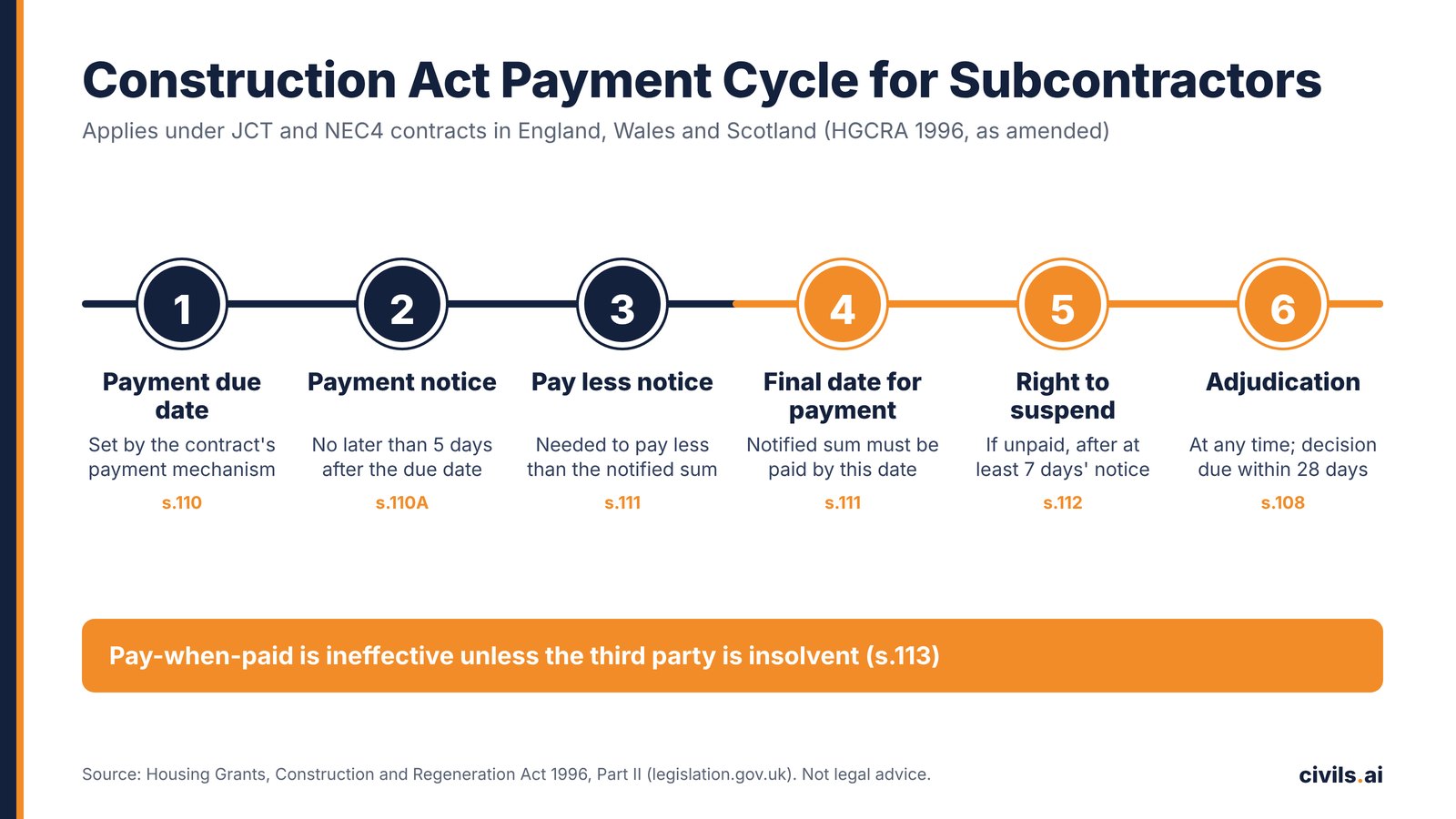
Part II of the Housing Grants, Construction and Regeneration Act 1996, as amended in 2009, applies to construction contracts in England, Wales and Scotland, sub-contracts included (contracts with residential occupiers are excluded). JCT builds compliance into its payment and dispute sections; NEC4 does so through Option Y(UK)2 (NEC). Whatever the form, the Act gives you a floor (legislation.gov.uk):
- Stage payments — you are entitled to interim payments unless the work is to last less than 45 days (s.109).
- A clear mechanism — the contract must say what becomes due and when, with a final date for payment. Payment conditional on obligations under another contract is generally not an adequate mechanism (s.110).
- Payment notices — a notice of the sum due must be given no later than 5 days after the payment due date (s.110A). If the payer fails to give one, you can give your own (s.110B).
- Pay less notices — the payer must pay the notified sum unless it gives a valid pay less notice in time (s.111).
- A right to suspend — if the notified sum is not paid by the final date, you can suspend after at least 7 days’ notice, with reasonable costs and an extension of time for the suspension period (s.112).
- No pay-when-paid — payment conditional on the payer being paid by someone else is ineffective, unless that third party is insolvent (s.113).
- Adjudication at any time — the adjudicator must decide within 28 days of referral, extendable by 14 days with the referring party’s consent (s.108).
Where a contract falls short, the Scheme for Construction Contracts fills the gap. The Act protects the process, not the outcome: you still need to apply on time and keep records.
Onerous Amendments to Check Before You Sign
JCT 2024 changed parts of the standard forms — email notices, new Relevant Events for epidemics and the exercise of statutory powers, and termination payment provisions reflecting the Construction Act (JCT). In the JCT 2024 Design and Build contract, the new events are optional Relevant Matters, so they carry money only if selected (Brodies). Check how your sub-contract particulars line up with the main contract.
The bigger risk is bespoke drafting. Look for:
- Shortened notice periods — a 7-week NEC4 period cut to days, or new JCT conditions precedent that bar claims for late notice.
- Back-to-back clauses — wording that makes your entitlement depend on what the main contractor recovers from the client. Check it against s.113.
- Extended payment cycles — long gaps between due date and final date, or payment notices tied to certificates you never see.
- Design and discrepancy risk — responsibility for errors in client or main contractor documents, or for “fitness for purpose”.
- Retention and set-off — high percentages, late release, and wide rights to deduct contra-charges.
For a wider framework, see how to analyse a construction contract before you sign. If you are on the main contractor side, set these expectations early in your request for bid template so tender returns flag departures from the standard form.
How AI Changes Subcontract Review
A subcontract pack — form, amendments, main contract extracts, Scope, programme — can run to hundreds of pages, and few subcontractors have a contracts team to read it all before the tender deadline.
Generic AI tools can summarise text but may state terms that are not in the document. Purpose-built construction AI tools read the whole pack and cite their sources.
Civils.ai’s AI construction contract review reads NEC, JCT, FIDIC or bespoke contracts, explains clauses in plain English and flags key risks, exclusions and obligations, each with a citation back to the page and clause. You can run the same checklist against every new subcontract — notice periods, payment terms, retention, liability caps, Z clauses — and cross-check contract requirements against drawings and specs.
Run a contract check for onerous amendments before you sign: upload the pack, run your checklist and take the flagged clauses to your commercial lead or solicitor. See Civils.ai pricing for plans. AI tells you where to look; a qualified person decides what it means and what to negotiate.
Subcontract Review Checklist
| Check | JCT (SBCSub) | NEC4 (ECS) |
|---|---|---|
| Form and edition | SBCSub or SBCSub/D, 2024 or earlier? | NEC4 ECS or an NEC3 form? Which main Option? |
| Amendments | Read the full schedule of amendments | Read every Option Z clause |
| Notices | Delay and loss and expense notice duties; any conditions precedent | Compensation event period (7 weeks unamended), quotation and reply periods |
| Payment | Due dates, final date, payment and pay less notices | Assessment dates, payment period, Option Y(UK)2 |
| Retention | Percentage and release triggers | Is Option X16 selected? On what terms? |
| Disputes | Adjudication nominating body; arbitration or litigation | Option W1 or W2; link to main contract disputes |
The Bottom Line
Neither form is safer by default. A JCT contract gives you familiar routes to time and money, but amended versions often add strict notice conditions. NEC4 rewards subcontractors who manage the contract week by week — early warnings, programme updates and compensation events notified within 7 weeks — and punishes those who wait for the final account.
Under both, the Construction Act protects payment and adjudication. Everything else depends on the amendments — read them before you price, not after you sign.
Frequently Asked Questions
Is JCT or NEC4 better for subcontractors?
Neither is better in itself. JCT separates Variations, extensions of time and loss and expense. NEC4 is more collaborative, but its time bars are strict. The amendments usually matter more than the choice of form.
What is the NEC4 time bar for subcontractors?
Under the unamended NEC4 Engineering and Construction Subcontract, a subcontractor has 7 weeks from becoming aware of a compensation event to notify it, against 8 weeks for the main contractor under the ECC. Amendments can shorten this, so check your own subcontract.
Can a JCT or NEC subcontract include pay-when-paid?
No, not effectively. Under s.113 of the Construction Act, a provision making payment conditional on the payer being paid by a third party is ineffective unless that third party is insolvent. Watch for “back-to-back” wording with the same effect.
Does NEC4 comply with the Construction Act?
Yes, when used with Option Y(UK)2, which NEC publishes to address the Housing Grants, Construction and Regeneration Act 1996. Check that it is selected in your Subcontract Data for UK work.