 Mary Janine L. Kamenić
 Julianna Widlund P.E
 Stevan Lukic CEng
How liquidated damages work on US construction projects, how they flow down from the owner to the GC to the subcontractor, and the contract terms subs and GC project managers should negotiate before signing.
Liquidated damages are one of the few contract terms that can turn a profitable job into a loss without anyone proving a single dollar of harm. A liquidated damages clause fixes, in advance, what the contractor pays for each day the work finishes late. On most US commercial projects that exposure starts in the owner–GC contract and is passed down to subcontractors through the subcontract. This guide explains how liquidated damages in construction are applied, when US courts treat them as penalties, how flow-down works, and what subcontractors can negotiate.
Quick Summary
| Topic | Key Finding |
|---|---|
| What LDs are | A pre-agreed amount, usually a rate per day, that the contractor pays if it misses the completion date in the contract. |
| When they fail | Under the general US rule, an amount that is unreasonably large compared with the anticipated or actual loss is an unenforceable penalty. Details vary by state. |
| How subs get exposed | Flow-down clauses bind the sub to the GC's obligations under the prime contract, which can include LDs, unless the subcontract says otherwise. |
| Where the risk hides | Uncapped LDs, short notice deadlines, narrow excusable delay lists, no-damages-for-delay clauses and one-sided consequential damages waivers. |
| How subs limit exposure | Proportionate assessment, a cap, LDs only if actually assessed against the GC, fair time extensions and workable notice periods. |
Key Term Definitions
Liquidated damages (LDs): A sum fixed in the contract that one party pays the other for a specific breach, most often late completion, in place of proving actual losses.
Penalty: A stipulated amount designed to punish or coerce rather than compensate. US courts generally refuse to enforce penalties.
Flow-down clause: A subcontract term that binds the subcontractor to the obligations the GC owes the owner under the prime contract, to the extent they apply to the sub's work.
Excusable delay: A delay the contract treats as outside the contractor's responsibility, which entitles it to a time extension so LDs do not run for that period.
No-damages-for-delay clause: A term that limits the contractor's remedy for delay to more time, with no added money.
What Are Liquidated Damages in Construction?
When a project finishes late, the owner loses rent, revenue, use of the facility, financing costs and extra design team fees. Proving those losses after the fact is slow and contested. A liquidated damages clause settles the question at the time of contracting. The parties agree on an amount for each day of delay, and if the contractor misses the completion date and is not entitled to more time, the owner recovers that amount without proving its real loss.
LDs usually attach to Substantial Completion, but contracts can also set them for interim milestones or phased turnovers, each a separate exposure.
How Liquidated Damages Are Calculated and Applied
Most construction LD clauses follow the same pattern: a stated amount per calendar day, running from the contract completion date (as adjusted by approved time extensions) until the work reaches the defined completion milestone. The rate itself is a business number the owner sets, ideally from its own forecast of what each day of delay will cost it.
US federal construction contracts show the logic clearly. The Federal Acquisition Regulation, Subpart 11.5 says LDs are not punitive, that the rate must be a reasonable forecast of just compensation for the harm caused by late performance, and that construction contracts with LDs must describe the rate assessed per day of delay. It also lists what the daily rate should include, such as the estimated daily cost of government inspection and superintendence. Private owners are not bound by the FAR, but courts look for the same link to probable loss.
In practice, LDs are usually withheld from progress payments, retainage or the final payment, and the GC back-charges its share to the subcontractor the same way.
Before pricing a job, check four things in the clause: the trigger date, the end milestone, whether the rate is calendar or working days, and whether there is a cap.
Liquidated Damages vs Actual Damages vs Penalties
The general US rule is set out in the Restatement (Second) of Contracts, Section 356: damages may be liquidated in the agreement, but only at an amount that is reasonable in light of the anticipated or actual loss caused by the breach and the difficulty of proving that loss. A term fixing unreasonably large liquidated damages is unenforceable as a penalty.
| Type | How the amount is set | What the owner must prove |
|---|---|---|
| Liquidated damages | Agreed in advance, usually per day | Late completion not excused under the contract |
| Actual damages | Calculated after the breach | The breach, causation and the amount of each loss |
| Penalty | Set to punish or pressure, out of proportion to likely loss | Generally unenforceable as written |
Do not assume an LD rate is a penalty just because it feels high. Courts generally allow more latitude where losses are hard to prove, as construction delay losses often are, and states differ on the test and how they treat owner-caused delay. This article is general information, not legal advice: get advice from a construction attorney licensed in the project's state before relying on any enforceability argument.
How Liquidated Damages Flow Down From GC to Subcontractor
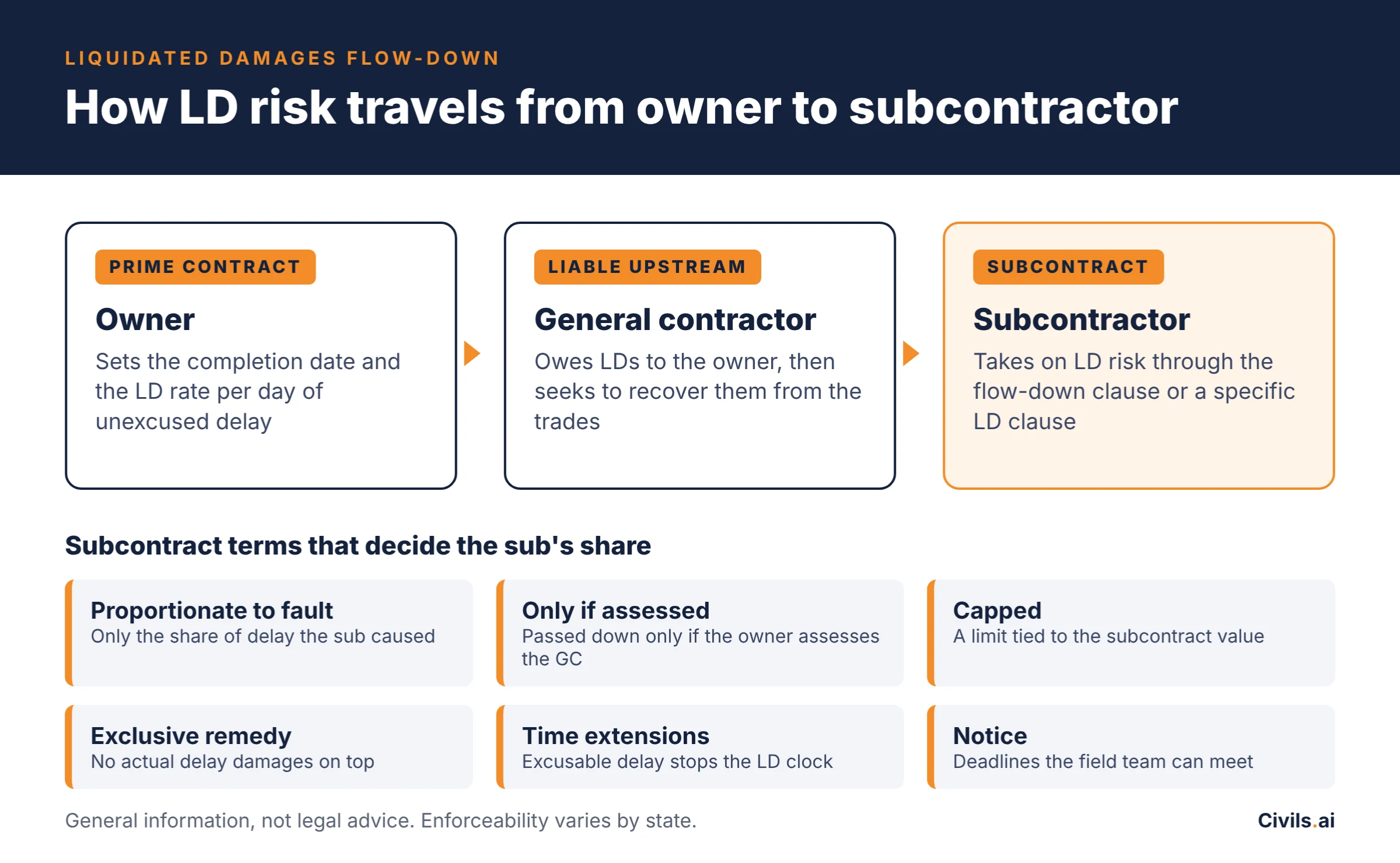
The owner–GC contract sets the LDs. The subcontract then decides how much of that risk reaches each trade. Two standard US forms show the range:
- AIA A401–2017 (Contractor–Subcontractor) — Article 2 says that, to the extent the prime contract applies to the subcontractor's work, the subcontractor assumes toward the contractor the obligations the contractor assumes toward the owner and architect, and the contractor gets the same rights and remedies against the sub that the owner has against the contractor. That broad flow-down can carry LD exposure with it. For background on the AIA family of documents, see our guide to understanding AIA contracts.
- ConsensusDocs 750 (Constructor–Subcontractor) — the ConsensusDocs 750 liquidated damages section lets the constructor assess a share of LDs against the sub in proportion to the sub's share of responsibility, capped at the amount actually assessed against the constructor. It also states that this does not limit the sub's liability for the constructor's actual damages caused by the sub.
Many GCs use their own subcontract forms, which may go further, for example by flowing down the full prime contract LD rate regardless of fault. The subcontract, not the prime contract, decides a sub's exposure.
Contract Terms That Decide Your Liquidated Damages Exposure
The LD rate gets the attention, but the surrounding clauses decide whether it is ever applied and how far it can go.
1. Caps on liquidated damages
A cap limits total LDs, for example as a share of the contract sum or a maximum number of days. Without one, exposure grows every day the job runs late. Even the FAR allows a maximum amount or period. In a subcontract, ask for a cap tied to your own subcontract value.
2. Sole and exclusive remedy
Check whether LDs are the only remedy for delay, or whether the GC can also claim actual delay damages on top. An exclusive-remedy clause puts a known ceiling on delay exposure.
3. Time extensions and excusable delay
LDs only run for delay the contract does not excuse. Read the list of excusable causes, such as owner-caused delay, changes, differing site conditions and severe weather. A narrow list, or one that grants time only "to the extent the GC obtains it from the owner," shifts risk to you. Change orders matter too, since every approved change should carry its time impact. See how to review change orders and unit rates.
4. Notice requirements
Most contracts require written notice of a delay or claim within a set period. Miss it and you may lose the time extension, which leaves LDs running. Note every deadline in the subcontract and the prime contract it incorporates, and check schedule reporting rules in the Division 1 general requirements.
5. No-damages-for-delay clauses
These give you time for delay but no money. Combined with LDs, you pay when you are late and absorb your own costs when others delay you. Enforceability varies, and some states limit them by statute. Virginia, for example, declares void public construction contract provisions that waive a contractor's right to recover damages for unreasonable delay. Others enforce them subject to exceptions developed by the courts.
6. Mutual waiver of consequential damages
The AIA A201–2017 General Conditions include a mutual waiver of consequential damages between owner and contractor, and state that the waiver does not preclude an award of liquidated damages when the contract provides for them. ConsensusDocs 750's waiver between constructor and sub excludes from the waiver any liquidated, consequential or other damages the owner is entitled to recover from the constructor. Read the waiver in your subcontract carefully: it may protect the GC far more than it protects you.
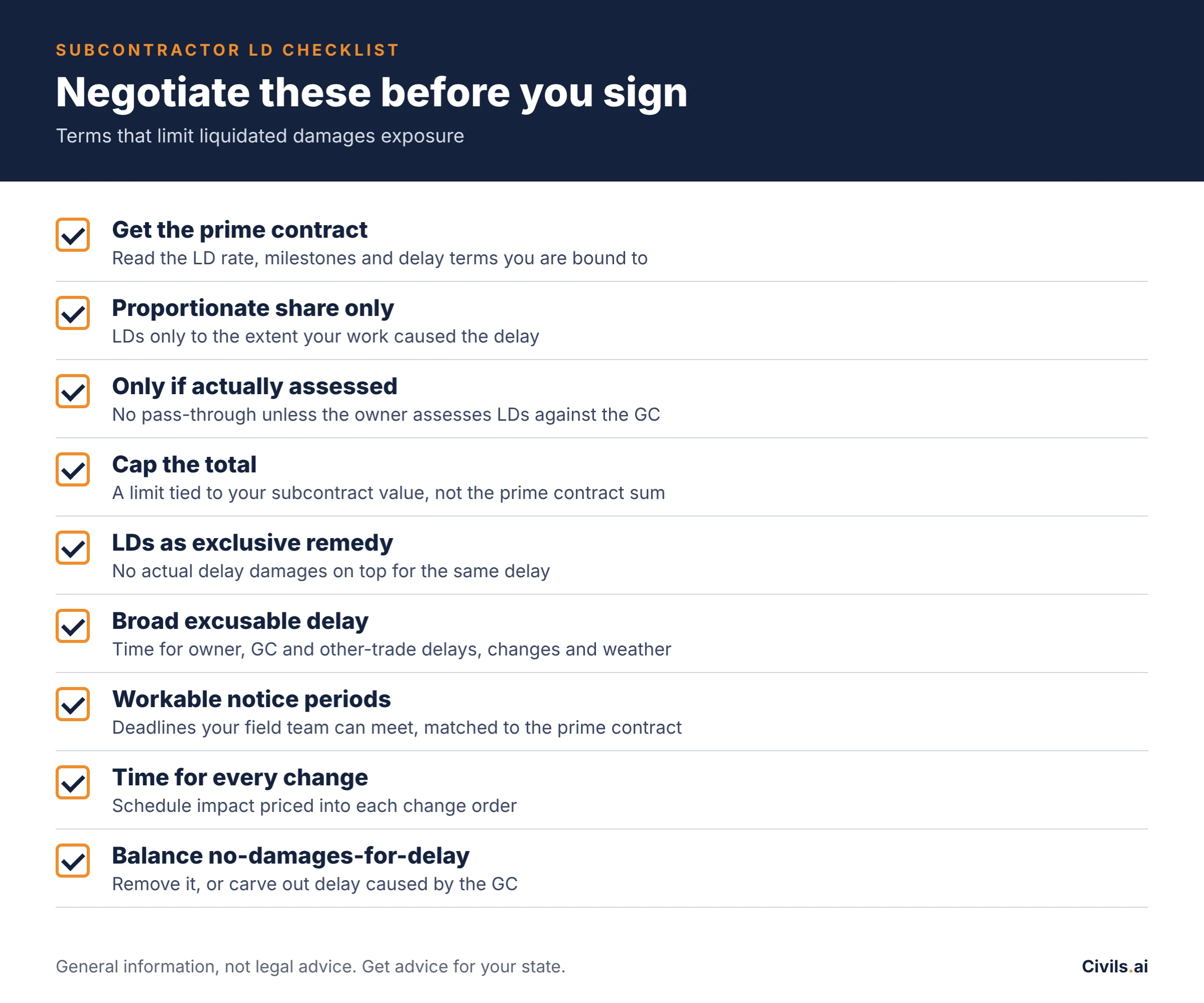
How Subcontractors Limit Liquidated Damages Exposure: Negotiation Checklist
Use this list before signing a subcontract with LDs. Several items mirror the ConsensusDocs 750 approach.
- Get the prime contract — read the LD clause, the rate, the milestones and the delay provisions you are being bound to.
- Proportionate share only — LDs assessed only to the extent your work caused the delay.
- Only if actually assessed — no pass-through unless the owner actually assesses and collects LDs from the GC.
- Cap the total — a limit tied to your subcontract value, not the prime contract sum.
- LDs as exclusive remedy — no actual delay damages on top of LDs for the same delay.
- Broad excusable delay — time for owner, GC and other-trade delays, changes, weather and events beyond your control.
- Workable notice periods — deadlines your field team can meet, matched to the prime contract.
- Time for every change — schedule impact priced into each change order before signing it.
- Remove or balance no-damages-for-delay — or carve out GC-caused delay.
- Mutual consequential damages waiver — one that protects you as well as the GC.
For a wider review routine covering indemnity, payment and scope, see how to analyze a construction contract before you sign.
What GC Project Managers Should Check Before Flowing LDs Down
GCs carry the owner's LDs and need to recover them from the trade that caused the delay. An overly aggressive flow-down can backfire: subs price the risk in, decline to bid or dispute every assessment.
- Match the subcontract to the prime — LD rate, milestones, notice deadlines and excusable delay causes should line up, so you are not liable upstream for delay you cannot pass down, or the reverse.
- Document causation — keep schedule updates, daily reports and delay notices that tie each delay to its cause. Our guide to construction dispute resolution covers how that record is used.
- Custom rates need support — if you set a different LD rate with a sub, be ready to show it is a reasonable estimate of your loss.
How AI Changes Contract Review for Liquidated Damages
LD risk is rarely in one place. The rate sits in the prime agreement, the cap in the general conditions, the notice periods in another article, the flow-down in the subcontract, and schedule rules in Division 1. Reconciling it by hand takes time that bid schedules rarely allow.
AI contract review makes that first pass fast and repeatable. With Civils.ai contract review, you upload the prime contract, subcontract and specs, and run a checklist of questions such as: "What is the liquidated damages rate and what milestone does it run to? Is there a cap? Are LDs the exclusive remedy for delay? What are the delay notice deadlines? Is there a no-damages-for-delay clause?" Civils.ai explains each clause in plain English and links every answer back to the exact page and clause, so your team can check the source.
- Consistent checks — save your LD checklist and run it on every new subcontract or tender pack.
- Cross-document conflicts — compare the subcontract against the prime contract and specs to find mismatched deadlines or rates.
AI review is a first read to support your team. It does not replace advice from a construction attorney on enforceability or negotiation. Check your contract for LD clauses with Civils.ai contract review, or see plans and pricing.
The Bottom Line
Liquidated damages reach most subcontractors through the flow-down clause, and the terms around the rate matter as much as the rate: caps, exclusive remedy, excusable delay and notice. Read the prime contract, negotiate a proportionate and capped share, and keep the notice record that protects your time extensions.
This article is general information and not legal advice. Laws on liquidated damages and delay clauses vary by state, so consult a qualified construction attorney about your contract.
Frequently Asked Questions
What are liquidated damages in construction?
Liquidated damages are an amount set in the contract, usually per day, that the contractor pays if it finishes late without an approved time extension. They replace the owner's need to prove its actual delay losses.
Are liquidated damages enforceable in the US?
Generally yes, if the amount is reasonable in light of the anticipated or actual loss and the difficulty of proving it. An unreasonably large amount can be struck down as a penalty. The test and its application vary by state.
Can a GC pass liquidated damages down to a subcontractor?
Yes, if the subcontract allows it, either through a specific LD clause or a broad flow-down clause. Subcontractors can negotiate to limit this to their proportionate share of the delay, capped at what the owner actually assesses.