 Mary Janine L. Kamenić
 Julianna Widlund P.E
 Stevan Lukic CEng
What an RFI in construction is, when to raise one, a copyable RFI template, and a step-by-step method for turning drawing and spec discrepancies into RFIs that get clear, fast answers.
An RFI in construction is how a contractor asks the design team a question in writing and gets an answer on the record. Good RFI construction practice is less about filling in a form and more about asking one clear question, with the right references, before the problem reaches the field or the bid. This guide covers what an RFI is and when to raise one, how it differs from a submittal and a change order, an RFI template you can copy, and a practical method for turning drawing and specification discrepancies into RFIs that the architect or engineer can answer quickly.
Quick Summary
| Topic | Key Finding |
|---|---|
| What an RFI is | A written request for clarification or missing information about the Contract Documents, sent to the party responsible for the design. |
| Contract basis | Under AIA A201-2017 §3.2.2, the contractor must promptly report errors, inconsistencies or omissions it discovers to the Architect as a request for information. |
| Standard form | AIA G716-2004 is a standard RFI form. Many projects use the contractor's or project platform's own format instead. |
| RFI vs change order | An RFI asks a question. It does not by itself authorize extra cost or time; that needs a change order or the contract's change process. |
| What makes a good RFI | One question, exact sheet and spec references, a proposed solution, a needed-by date and a note on possible cost or schedule impact. |
| Where AI helps | Discrepancy checking tools cross-check sheets and specs and cite the exact page, so the team reviews findings and writes RFIs instead of hunting for conflicts. |
Key Term Definitions
RFI (Request for Information): A formal written question from one project party to another, usually from the contractor to the architect or engineer, asking for clarification of the drawings, specifications or other Contract Documents.
Discrepancy: Two parts of the Contract Documents that describe the same work differently, such as a drawing and a spec section, a plan and a schedule, or an addendum and the base set.
Submittal: Shop drawings, product data, samples and similar documents the contractor sends for review to show how it will meet the Contract Documents.
Change order: A written modification to the contract, agreed by the parties, that changes the work, the contract sum, the contract time or a combination of these.
What Is an RFI in Construction?
A construction RFI is a written question about the documents. When the contractor or a subcontractor cannot build or price something with confidence from the documents as issued, the RFI is the formal way to get an answer.
On projects using AIA contracts, this is more than good practice. AIA A201-2017 §3.2.2 requires the contractor, before starting each portion of the work, to study and compare the Contract Documents and to promptly report any errors, inconsistencies or omissions it discovers to the Architect as a request for information, in such form as the Architect may require (see AIA A201-2017). Other contract forms handle this differently, so check your general and supplementary conditions for RFI procedures and response times. For background on the AIA family of documents, see our guide to understanding AIA contracts.
When to raise an RFI
- Conflicting information — a drawing and a spec section, or two drawings, show the same item differently.
- Missing information — a dimension, detail, elevation, product or connection the work needs is not shown anywhere.
- Unclear design intent — the documents can be read two reasonable ways and the choice affects cost, sequence or quality.
- Field conditions that differ from the documents — existing conditions found on site do not match what was drawn.
- Constructability problems — the work as drawn cannot reasonably be built, or clashes with another trade.
When not to raise an RFI
RFIs are not the place to ask questions the documents already answer, to propose substitutions (most specs route those through a substitution request procedure), or to seek approval of shop drawings (that is a submittal). Before bids are due, questions usually go through the pre-bid question process set out in the bidding instructions rather than a formal construction-phase RFI.
RFI vs Submittal vs Change Order
| Document | Purpose | Who starts it | Changes cost or time? |
|---|---|---|---|
| RFI | Ask for clarification or missing information | Usually the contractor, often on behalf of a subcontractor | Not by itself. The answer may lead to a change. |
| Submittal | Show how the contractor will meet the documents (shop drawings, product data, samples) | Contractor, from subcontractors and suppliers | No. Submittals are reviewed against the documents. |
| Change order | Formally change the work, contract sum or contract time | Owner, architect and contractor agree it | Yes. That is its purpose. |
The AIA's own instructions for its G716 RFI form note that neither the request nor the response authorizes work that increases the cost or time of the project (see AIA G716 instructions). If an RFI answer adds scope, flag it straight away and follow the contract's change process. For more on submittals, see our guide to building a submittal register from the spec; for change orders, see how to extract data for change order review.
What a Good Construction RFI Contains
An architect or engineer answering an RFI should not have to hunt for context. The AIA G716 form asks the requesting party to describe the information needed, list the drawings, specifications or submittals reviewed, give a requested reply date, and optionally recommend a solution, with space for the receiver's response. Whatever format your project uses, a good RFI carries the same core content:
- One question per RFI — bundled questions get partial answers and are hard to close.
- Exact references — sheet numbers, detail callouts, gridlines, spec section and paragraph.
- What you found — a factual statement of the conflict or gap, quoting both sources.
- A proposed solution — your recommended answer, so the designer can confirm rather than start from scratch.
- Impact — whether the answer could affect cost, schedule or other trades, stated without pre-judging entitlement.
- Needed-by date — tied to the schedule activity that depends on the answer, and consistent with any response time in the contract.
RFI Template You Can Copy
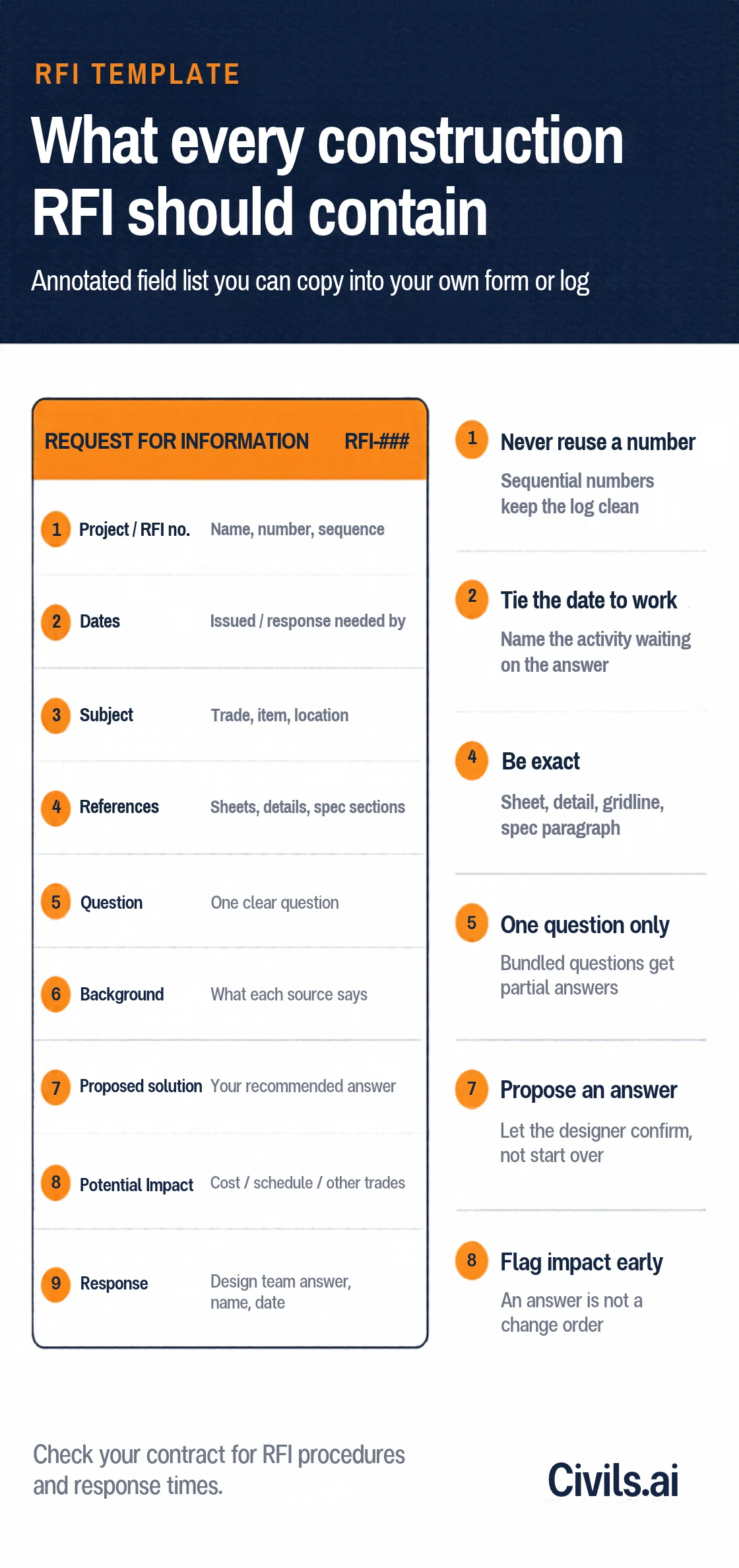
Use this RFI template as a field list for your own form, spreadsheet or project management platform. Copy the table and fill in the right-hand column.
| Field | What to enter |
|---|---|
| Project name and number | As shown on the contract and title block |
| RFI number | Sequential, never reused (for example RFI-001); add a revision suffix if resubmitted |
| To / From | Recipient (architect or engineer of record) and sender, with company and contact details |
| Date issued | Date the RFI is sent |
| Response needed by | Date, plus the activity it affects |
| Subject | Short, searchable title: trade, item, location |
| Discipline / spec section | For example plumbing, Division 22 section number from the project manual |
| References | Sheet and detail numbers, gridlines, spec paragraphs, submittals or prior RFIs reviewed |
| Question | One question that can be answered directly |
| Background | What each source says, quoted or described exactly |
| Proposed solution | Your recommended answer |
| Potential impact | Cost: possible / none known. Schedule: possible / none known. Other trades affected |
| Attachments | Marked-up sheet extracts, photos, spec excerpts |
| Response | Completed by the design team, with responder name and date |
| Follow-up | Closed / revised drawing issued / change request raised |
How to Turn Drawing and Spec Discrepancies Into RFIs
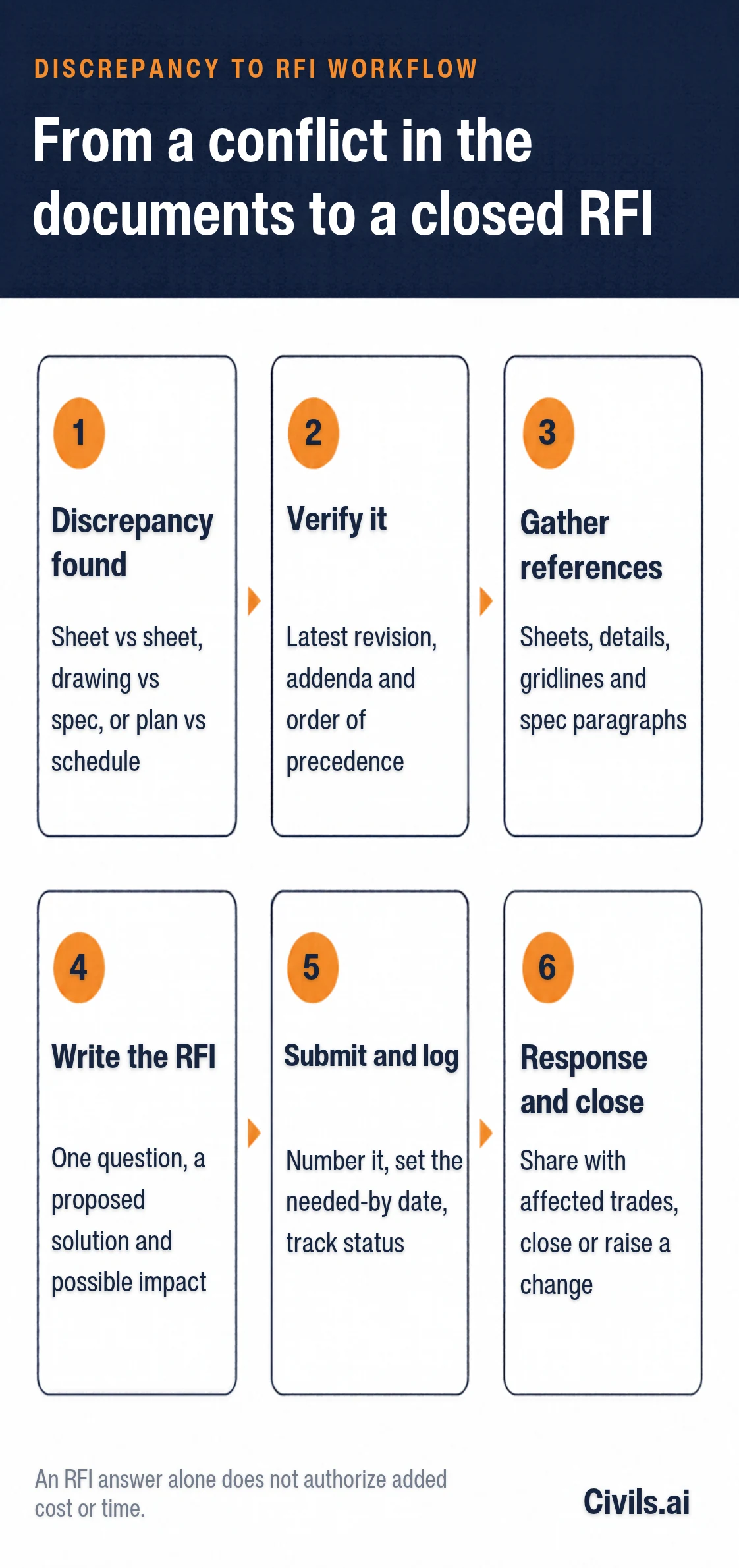
Most RFIs start as a discrepancy spotted during estimating, buyout, coordination or layout. What separates a quick answer from an RFI that bounces back is the work done before it is written.
1. Confirm the discrepancy is real
Check that you are on the current revision of every sheet and have read every addendum and bulletin. Our guide to tracking addenda before bid day covers how to keep the set current.
2. Check whether the documents already resolve it
Read the order-of-precedence provisions in the contract and any general notes on the drawings. Even when a precedence rule points one way, a short RFI confirming intent is often cheaper than building the wrong thing. Our article on drawing vs spec conflicts explains how precedence clauses work.
3. Gather every reference
Note each sheet, detail, schedule and spec paragraph involved, and search for other places the same item appears.
4. Write one clear question with a proposed answer
State what each document says, then ask a question that can be answered with a decision. Offer your recommended solution and say whether it affects cost, schedule or other trades.
5. Submit, log and track it
Give the RFI a number, enter it in the RFI log, and set a reminder for the needed-by date. When the response arrives, distribute it to every affected trade and record whether it closes the issue or triggers a change.
Example: turning a discrepancy into an RFI
The example below is illustrative; sheet numbers and sizes are made up to show the structure. A plumbing subcontractor's estimator notices that the floor plan and the riser diagram size the same cold-water branch differently.
Weak RFI: "Please clarify pipe sizes on plumbing drawings."
Strong RFI: "Subject: Plumbing, cold-water branch size to Level 2 restroom group. Sheet P-201 shows the branch at 1 in.; riser diagram P-601 shows the same branch at 3/4 in. Spec section reviewed does not state a size for this branch. Question: Which size governs? Proposed solution: install at 1 in. per P-201. Potential impact: none known if 1 in. is confirmed before rough-in; schedule impact possible if the answer is not received before rough-in starts on Level 2."
The strong version names the item and location, quotes both sources, asks one question, proposes an answer and ties the date to a real activity.
Keeping an RFI Log
An RFI log shows what was asked, when, who answered and what changed as a result, which gives later cost and schedule discussions a date trail. A useful log has these columns:
- RFI number and subject
- Discipline and spec section
- Originator (including the subcontractor that raised it)
- Date sent, date needed and date answered
- Status — open, answered, closed, or answered with follow-up
- Cost or schedule flag — and the linked change request number if one was raised
- Revised documents issued — sketch, bulletin or revised sheet reference
Review open RFIs at every coordination meeting.
RFI Construction Mistakes to Avoid
- Asking what the documents already answer — it wastes the designer's time and weakens the RFIs that matter.
- Vague references — "see drawings" forces the reviewer to find the problem for you.
- Several questions in one RFI — partial answers leave the RFI half open.
- No proposed solution — the designer starts from zero, and the answer takes longer.
- Treating the answer as a change order — an RFI response alone is not authorization for added cost or time.
- Raising it too late — a conflict found at rough-in costs more to resolve than one found at estimating or buyout.
- Not closing the loop — answers that never reach the crew or the subcontractor do not prevent rework.
How AI Changes RFI Work in Construction
Writing a good RFI is quick. Finding the discrepancy in the first place is slow: reading sheet against sheet, schedule against plan and drawing against spec. On a large set, many conflicts are only found once the work is in the field.
AI discrepancy checking moves that search earlier. With Civils.ai Discrepancy Check, you upload drawings alongside the specifications, and the AI cross-checks them for issues, each with a citation back to the exact sheet or clause:
- Sheet-to-sheet discrepancies — dimensions, levels or tags that differ between plans, sections, details and schedules.
- Drawing-to-spec discrepancies — a material, product or grade on the drawing that differs from the spec section covering it.
- Cross-discipline conflicts — for example, a structural slab thickness that differs from the architectural build-up.
- Building code checks — noted values checked against the codes in your library.
Because every finding links to its source page, each one already carries the references an RFI needs. Your team opens the citation, confirms the issue, and decides whether it becomes an RFI, a note in the estimate or nothing at all.
AI findings are a starting point for review, not a replacement for a qualified person reading the documents. Whether a conflict is worth an RFI, and how to word it, remains your judgment.
Run a discrepancy check on your drawings and specs with Civils.ai, or see plans and pricing.
Frequently Asked Questions
What does RFI stand for in construction?
RFI stands for Request for Information. It is a written question, usually from the contractor to the architect or engineer, asking for clarification of the drawings, specifications or other Contract Documents.
Who answers an RFI?
Usually the architect or engineer of record, through the channel set out in the contract. Subcontractor RFIs normally go through the general contractor.
How long does the design team have to answer an RFI?
It depends on the contract. Some contracts or specifications set a response period; others require a reasonable time. Check the general conditions, supplementary conditions and Division 01 for your project.
Is there a standard RFI form?
Yes. AIA Document G716-2004 is a standard Request for Information form. Many contractors and project platforms use their own formats with similar fields, such as the RFI template in this article.
Can an RFI change the contract price?
Not by itself. If the answer adds work, cost or time, the change has to go through the contract's change process, such as a change order.